
Food & genetics
Why is cheese easier on my stomach than milk?
A glass of milk leaves you bloated. A little aged cheese feels fine. The difference may come down to the sugar left in each serving.
Meet the enzyme that digests milk sugar
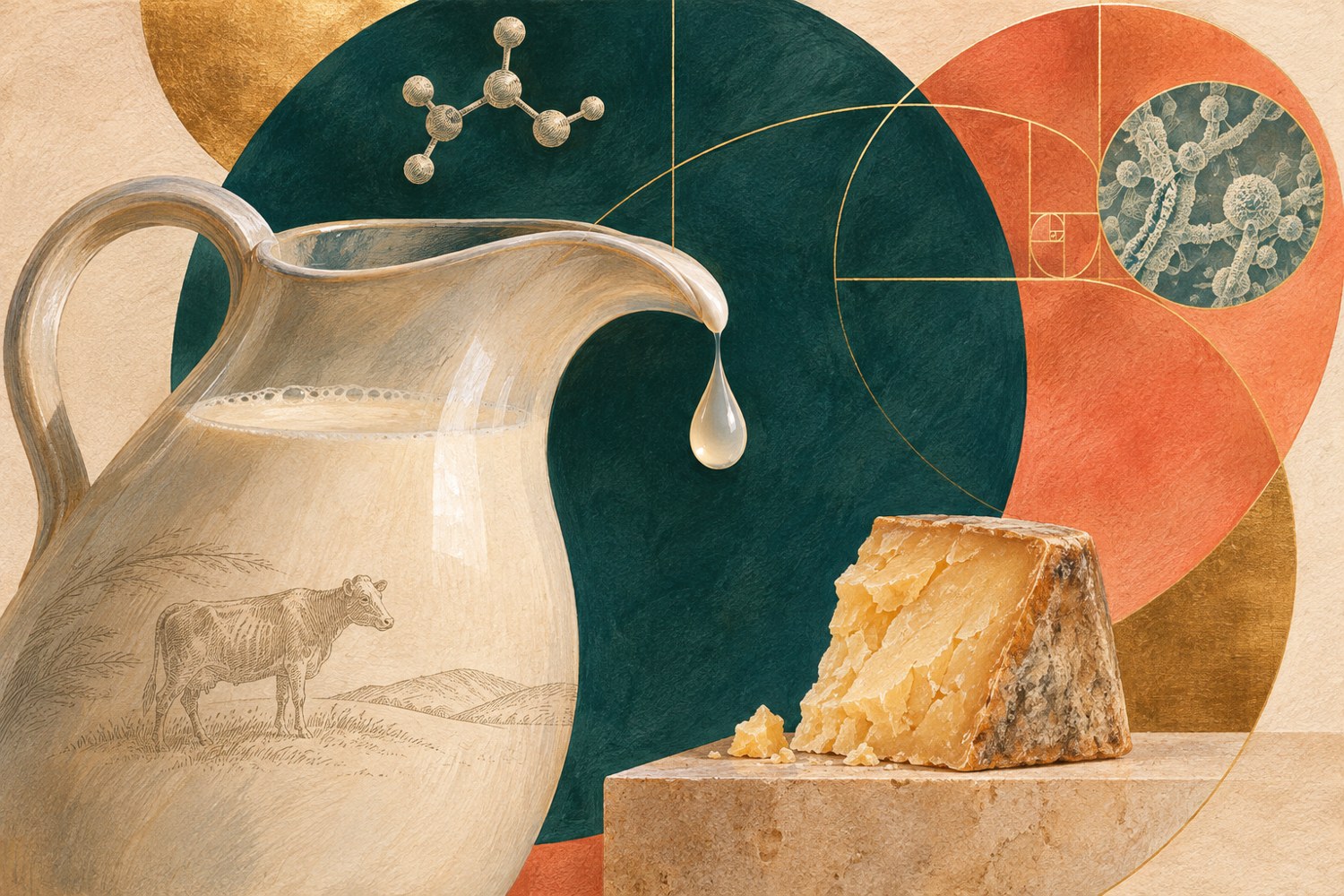
Milk and aged cheese belong to the same food family, but they need not present the same digestive challenge. Lactose is the natural sugar in milk. In the small intestine, the enzyme lactase breaks lactose into smaller sugars that the body can absorb. The gene LCT provides the instructions for making that enzyme. A gene is a stretch of DNA containing instructions for a biological product, such as a protein. For many people, lactase production gradually decreases after childhood. When lactose escapes digestion and reaches the large intestine, bacteria can ferment it, producing gas. That connects a genetic influence on enzyme production with an everyday experience such as bloating. It does not mean that every uncomfortable response to dairy has a genetic explanation.
The genetic switch beside LCT
Making lactase depends not only on the enzyme’s instructions but also on how those instructions are regulated. MCM6 contains regulatory elements that help control the nearby LCT gene. This is a useful example of why a DNA change can matter even when it does not alter the instructions for the enzyme itself: it can affect whether those instructions remain active. A variant is a difference in DNA sequence. The supplied term lactase-persistence regulatory variants describes changes that sustain LCT expression after infancy. People with lactase persistence continue producing lactase into adulthood. Common adult lactase nonpersistence is different from the rare congenital deficiency caused by certain LCT variants. For this everyday milk-versus-cheese question, the relevant distinction is usually adult enzyme production, not a rare condition present from birth.
Why one genetic marker cannot tell the whole story
Lactase persistence is associated with multiple regulatory variants found in different ancestry backgrounds. There is no single universal marker that captures every person’s genetic basis for persistence. A result therefore needs to be interpreted in light of which variants were examined, rather than treated as a complete account of dairy digestion. Genotype means the genetic variants a person carries. Phenotype means an observable characteristic, such as ongoing lactase production or symptoms after a particular food. These are related but not interchangeable. An association is a pattern linking a variant with a trait; it is not, by itself, proof of causation for an individual’s symptoms. The regulatory mechanism supports a biological explanation, but genetics alone cannot establish why yesterday’s glass of milk caused discomfort.
Portion and preparation both count
The amount of lactose reaching the intestine depends on the food and the serving, not just on genetic background. Hard, aged cheeses usually contain less lactose than milk. Fermentation and preparation can change the lactose left in a food. A little aged cheese may therefore pose a different challenge from a glass of milk, even though both come from dairy. Some people also tolerate yogurt or a small glass of milk with a meal. These examples are possibilities, not promises. Portion size matters because it changes the amount of lactose to be digested. Comparing foods without comparing quantities can obscure that difference. Tolerating one cheese serving does not prove lactase persistence, just as discomfort after a larger milk serving does not establish a particular genotype.
Lactose-free does not mean milk-free
Separating milk sugar from milk protein makes the supermarket choice easier to understand. Lactose-free cow’s milk still supplies milk protein and calcium. Its different lactose content does not make it free of the proteins that can trigger milk allergy. Lactose intolerance concerns difficulty digesting lactose; milk allergy is a different condition. A genetic clue about lactase production cannot turn one into the other. Common genetic markers, often called SNPs, do not diagnose milk allergy or secondary lactose intolerance. Secondary intolerance can follow a problem affecting the small intestine, rather than the usual inherited pattern of decreasing lactase production. This is another reason not to interpret every dairy symptom through LCT or MCM6 alone. A clinician can consider explanations that a common-variant result cannot resolve.
Use genetics as context, not a verdict
A useful interpretation brings three pieces together: the genetic tendency to maintain lactase, the lactose in the food, and the symptoms actually experienced. None should replace the others. Someone’s DNA does not change between breakfast and dinner, but the dairy product, portion and meal context can differ. Those ordinary differences help explain why tolerance need not look identical at every eating occasion. Genetics can clarify the biology without prescribing a single menu. The evidence supports a role for LCT regulation and ancestry-specific persistence variants; it does not promise symptom-free eating or explain every digestive complaint. For RobGenes readers, the constructive question is not simply “Can my genes handle dairy?” It is “How does my genetic background fit with the foods, amounts and symptoms I observe?”
Sources & further reading
- NIDDK · Lactose intolerance ↗
- MedlinePlus Genetics · LCT gene ↗
- MedlinePlus Genetics · MCM6 gene ↗
- MedlinePlus Genetics · Lactose intolerance and inheritance ↗
Educational reading to enrich your conversation with a healthcare professional, interpreted in the context of your own health and needs.